Apache Parquet is a free and open-source column-oriented data storage format in the Apache Hadoop ecosystem inspired by Google Dremel interactive ad-hoc query system for analysis of read-only nested data. It is similar to RCFile and ORC, the other columnar-storage file formats in Hadoop, and is compatible with most of the data processing frameworks around Hadoop. It provides data compression and encoding schemes with enhanced performance to handle complex data in bulk. == History == The open-source project to build Apache Parquet began as a joint effort between Twitter and Cloudera using the record shredding and assembly algorithm as described in Google's Dremel. Parquet was designed as an improvement on the Trevni columnar storage format created by Doug Cutting, the creator of Hadoop. The name 'parquet' (lit. 'small compartment') refers to a style of decorative flooring and was chosen to "evoke the bottom layer of a database with an interesting layout". The first version, Apache Parquet 1.0, was released in July 2013. Since April 27, 2015, Apache Parquet has been a top-level Apache Software Foundation (ASF)-sponsored project. == Features == Apache Parquet is implemented using the record-shredding and assembly algorithm, which accommodates the complex data structures that can be used to store data. The values in each column are stored in contiguous memory locations, providing the following benefits: Column-wise compression is efficient in storage space Encoding and compression techniques specific to the type of data in each column can be used Queries that fetch specific column values need not read the entire row, thus improving performance Apache Parquet is implemented using the Apache Thrift framework, which increases its flexibility; it can work with a number of programming languages like C++, Java, Python, PHP, etc. As of August 2015, Parquet supports the big-data-processing frameworks including Apache Hive, Apache Drill, Apache Impala, Apache Crunch, Apache Pig, Cascading, Presto and Apache Spark. It is one of the external data formats used by the pandas Python data manipulation and analysis library. == Compression and encoding == In Parquet, compression is performed column by column, which enables different encoding schemes to be used for text and integer data. This strategy also keeps the door open for newer and better encoding schemes to be implemented as they are invented. Parquet supports various compression formats: snappy, gzip, LZO, brotli, zstd, and LZ4. === Dictionary encoding === Parquet has an automatic dictionary encoding enabled dynamically for data with a small number of unique values (i.e. below 105) that enables significant compression and boosts processing speed. === Bit packing === Storage of integers is usually done with dedicated 32 or 64 bits per integer. For small integers, packing multiple integers into the same space makes storage more efficient. === Run-length encoding (RLE) === To optimize storage of multiple occurrences of the same value, run-length encoding is used, which is where a single value is stored once along with the number of occurrences. Parquet implements a hybrid of bit packing and RLE, in which the encoding switches based on which produces the best compression results. This strategy works well for certain types of integer data and combines well with dictionary encoding. == Cloud Storage and Data Lakes == Parquet is widely used as the underlying file format in modern cloud-based data lake architectures. Cloud storage systems such as Amazon S3, Azure Data Lake Storage, and Google Cloud Storage commonly store data in Parquet format due to its efficient columnar representation and retrieval capabilities. Data lakehouse frameworks—including Apache Iceberg, Delta Lake, and Apache Hudi —build an additional metadata layer on top of Parquet files to support features such as schema evolution, time-travel queries, and ACID-compliant transactions. In these architectures, Parquet files serve as the immutable storage layer while the table formats manage data versioning and transactional integrity. == Comparison == Apache Parquet is comparable to RCFile and Optimized Row Columnar (ORC) file formats — all three fall under the category of columnar data storage within the Hadoop ecosystem. They all have better compression and encoding with improved read performance at the cost of slower writes. In addition to these features, Apache Parquet supports limited schema evolution, i.e., the schema can be modified according to the changes in the data. It also provides the ability to add new columns and merge schemas that do not conflict. Apache Arrow is designed as an in-memory complement to on-disk columnar formats like Parquet and ORC. The Arrow and Parquet projects include libraries that allow for reading and writing between the two formats. == Implementations == Known implementations of Parquet include:
Robinson compass mask
In image processing, a Robinson compass mask is a type of compass mask used for edge detection. It has eight major compass orientations, each will extract the edges in respect to its direction. A combined use of compass masks of different directions could detect the edges from different angles. == Technical explanation == The Robinson compass mask is defined by taking a single mask and rotating it to form eight orientations: North: [ − 1 0 1 − 2 0 2 − 1 0 1 ] {\displaystyle {\text{North:}}{\begin{bmatrix}-1&0&1\\-2&0&2\\-1&0&1\end{bmatrix}}} North West: [ 0 1 2 − 1 0 1 − 2 − 1 0 ] {\displaystyle {\text{North West:}}{\begin{bmatrix}0&1&2\\-1&0&1\\-2&-1&0\end{bmatrix}}} West: [ 1 2 1 0 0 0 − 1 − 2 − 1 ] {\displaystyle {\text{West:}}{\begin{bmatrix}1&2&1\\0&0&0\\-1&-2&-1\end{bmatrix}}} South West: [ 2 1 0 1 0 − 1 0 − 1 − 2 ] {\displaystyle {\text{South West:}}{\begin{bmatrix}2&1&0\\1&0&-1\\0&-1&-2\end{bmatrix}}} South: [ 1 0 − 1 2 0 − 2 1 0 − 1 ] {\displaystyle {\text{South:}}{\begin{bmatrix}1&0&-1\\2&0&-2\\1&0&-1\end{bmatrix}}} South East: [ 0 − 1 − 2 1 0 − 1 2 1 0 ] {\displaystyle {\text{South East:}}{\begin{bmatrix}0&-1&-2\\1&0&-1\\2&1&0\end{bmatrix}}} East: [ − 1 − 2 − 1 0 0 0 1 2 1 ] {\displaystyle {\text{East:}}{\begin{bmatrix}-1&-2&-1\\0&0&0\\1&2&1\end{bmatrix}}} North East: [ − 2 − 1 0 − 1 0 1 0 1 2 ] {\displaystyle {\text{North East:}}{\begin{bmatrix}-2&-1&0\\-1&0&1\\0&1&2\end{bmatrix}}} The direction axis is the line of zeros in the matrix. Robinson compass mask is similar to kirsch compass masks, but is simpler to implement. Since the matrix coefficients only contains 0, 1, 2, and are symmetrical, only the results of four masks need to be calculated, the other four results are the negation of the first four results. An edge, or contour is an tiny area with neighboring distinct pixel values. The convolution of each mask with the image would create a high value output where there is a rapid change of pixel value, thus an edge point is found. All the detected edge points would line up as edges. == Example == An example of Robinson compass masks applied to the original image. Obviously, the edges in the direction of the mask is enhanced.
Nolot
Nolot is a chess test suite with 11 positions from real games. They were compiled by Pierre Nolot (French: [nɔ.lo]) for the French chess magazine Gambisco and posted on the rec.games.chess Usenet group in 1994. They were designed to be particularly hard to solve for chess engines to solve at the time, although modern engines can find a solution near-instantaneously. == Problem 1 == FEN: r3qb1k/1b4p1/p2pr2p/3n4/Pnp1N1N1/6RP/1B3PP1/1B1QR1K1 w - - 0 1 26.Nxh6!! c3 (26... Rxh6 27.Nxd6 Qh5 (best) 28.Rg5! Qxd1 29.Nf7+ Kg8 30.Nxh6+ Kh8 31.Rxd1 c3 32.Nf7+ Kg8 33.Bg6! Nf4 34.Bxc3 Nxg6 35.Bxb4 Kxf7 36.Rd7+ Kf6 37.Rxg6+ Kxg6 38.Rxb7 ±) 27.Nf5! cxb2 28.Qg4 Bc8 (28... g6!? 29.Kh2! 29.Qd7 30.Nh4 Bc6 31.Nc5! dxc 32.Rxe6 Nf6 33.Nxg6+ Kg7 34.Qg5 Nbd5 35.Ne5 Kh8 36.Nxd7 ±) 29.Qh4+ Rh6 30.Nxh6 gxh6 31.Kh2! Qe5 32.Ng5 Qf6 33.Re8 Bf5 34.Qxh6 (missing a mate in 6: 34.Nf7+ Qxf7 35.Qxh6+ Bh7 36.Rxa8 Nf6 37.Rxf8 Qxf8 38.Qxf8+ Ng8 39.Qg7#) 34...Qxh6 35.Nf7+ Kh7 36.Bxf5+ Qg6 37.Bxg6+ Kg7 38.Rxa8 Be7 39.Rb8 a5 40.Be4+ Kxf7 41.Bxd5+ 1–0 The best Novag computer, the Diablo 68000, finds 26. Nxh6 after seven and a half months (Pierre Nolot has let it run on the position for 14 months and one day, until a power failure stopped an analysis of over 80,000,000,000 nodes.) but for wrong reasons: it evaluates white's position as inferior and thinks this move would enable it to draw. Today Gambit Tiger 2.0 for example can find it quite quickly: Most free engines running on 64-bit processors in 2010 could solve this problem and the others in a few seconds. 1.Qd4 c3 2.Bxc3 Nxc3 3.Qxb4 Nxe4 4.Qxb7 Rb8 5.Qxb8 Qxb8 6.Bxe4 d5 7.Rb1 μ (-1.20) Depth: 12 00:00:09 6055 kN 1.Nxh6 c3 2.Nf5 cxb2 3.Qg4 Rb8 4.Nxg7 Rg6 5.Qxg6 Qxg6 6.Rxg6 Bxg7 7.Nxd6 ³ (-0.48) Depth: 12 00:00:21 14368 kN 1.Nxh6 c3 2.Nf5 cxb2 3.Qg4 Rc8 4.Nxg7 Rg6 5.Nxe8 Rxg4 6.Rxg4 Rxe8 7.Rg6 μ (-0.74) Depth: 13 00:00:55 38455 kN 1.Ne3 Rxe4 2.Bxe4 Qxe4 3.Nxd5 Qxd5 4.Qc1 Qf5 5.Qxh6+ Qh7 6.Qe6 Nd3 7.Re2 Nxb2 8.Rxb2 ³ (-0.58) Depth: 13 00:01:30 62979 kN 1.Ne3 Rxe4 ³ (-0.58) Depth: 14 00:02:02 84941 kN 1.Ne3 Nxe3 2.Rexe3 Bxe4 3.Qg4 Rg6 4.Qxe4 Qxe4 5.Bxe4 Rxg3 6.Rxg3 d5 7.Bf5 Re8 8.Bc3 ³ (-0.30) Depth: 15 00:03:05 128968 kN 1.Nxh6 ² (0.32) Depth: 15 00:07:58 350813 kN With the next ply showing a clear advantage. Stockfish 14dev 64bit 4CPU running on 2020 hardware recognises the significance of Nxh6!! in 1 second. Stockfish_21092606_x64_avx2: NNUE evaluation using nn-13406b1dcbe0.nnue enabled. 19/32 00:01 7708k 4882k +3,00 Nxh6 Rxh6 Nxd6 Qh5 Bg6 Qxd1 Nf7+ Kg8 Nxh6+ gxh6 Bh5+ Kh7 Rxd1 c3 Bxc3 Nxc3 Rd7+ Kh8 Rxb7 Ne4 Re3 Nxf2 Kxf2 Bc5 Ke2 Bxe3 Kxe3 Nd5+ Kf2 49/73 15:02 5118270k 5673k +6,15 Nxh6 Rxh6 Nxd6 Qh5 Rg5 Qxd1 Nf7+ Kg8 Nxh6+ Kh8 Rxd1 c3 Nf7+ Kg8 Bg6 Nf4 Bxc3 Nbd5 Rb1 Bc6 Bd2 Nxg6 Rxg6 Ne7 Rxc6 Nxc6 Rb6 Rc8 Ng5 a5 Ra6 Bb4 Be3 Ne5 Bd4 Nc6 Bb6 Bd2 h4 Kf8 Bc5+ Kg8 Be3 Bxe3 fxe3 Kf8 Kf2 Ke7 Nf3 Kd7 Rb6 Ne7 Rb5 Kd6 Rxa5 Rc2+ Kg3 Re2 Nd4 Rxe3+ Kf4 Rd3 Nf5+ Kc7 Nxe7 == Problem 2 == FEN: r4rk1/pp1n1p1p/1nqP2p1/2b1P1B1/4NQ2/1B3P2/PP2K2P/2R5 w - - 0 1 22.Rxc5!! Nxc5 23.Nf6+ Kh8 24.Qh4 Qb5+ (computers think there is perpetual check here, but...) 25.Ke3! 25... h5 26.Nxh5 Qxb3+ (26... d5+ 27.Bxd5 Qd3 28.Kf2 Ne4+ 29.Bxe4 Qd4+ 30.Kg2 Qxb2+ 31.Kh3 ±) and White won in 41 moves. Today Deep Junior 8.ZX for example finds it very quickly (around 1 minute): 1.Kd1 Rac8 2.Bh6 Qb5 3.Rc3 Qf1+ 4.Kc2 Rc6 5.Bxf8 −+ (-2.11) Depth: 12 00:00:04 10422 kN 1.Nxc5 Nxc5 2.Rxc5 Qxc5 3.e6 Rae8 4.e7 Nc8 5.Kf1 Nxd6 6.Bf6 b5 −+ (-2.10) Depth: 12 00:00:14 25054 kN 1.Bf6! μ (-1.35) Depth: 12 00:00:17 34601 kN 1.Bf6 Qb5+ 2.Ke1 Bb4+ 3.Kf2 Bc5+ = (0.00) Depth: 12 00:00:20 34601 kN 1.Bf6 Qb5+ 2.Ke1 Nxf6 3.Nxf6+ Kg7 4.Nh5+ gxh5 5.Qf6+ Kg8 6.Qg5+ Kh8 7.Qf6+ = (0.00) Depth: 15 00:01:01 130544 kN 1.Rxc5! = (0.15) Depth: 15 00:01:12 145875 kN 1.Rxc5 Nxc5 2.Nf6+ Kh8 3.Qh4 Qb5+ 4.Ke3 h5 5.Nxh5 Qd3+ 6.Kf2 Ne4+ 7.fxe4 Qd4+ 8.Kf1 Qd3+ 9.Ke1 Qb1+ 10.Bd1 ± (2.18) Depth: 15 00:01:18 145875 kN Stockfish 14dev 64bit 4CPU running on 2020 hardware recognises the significance of Rxc5!! in 1 second. Stockfish_21092606_x64_avx2: NNUE evaluation using nn-13406b1dcbe0.nnue enabled. 21/25 00:01 5822k 5545k +6,61 Rxc5 Qxc5 Nxc5 Nxc5 Bh6 Nbd7 Bxf8 Rxf8 Qe3 Rc8 f4 Nxe5 Qxe5 Ne6 Bxe6 Rc2+ Kd3 Rxh2 46/86 11:27 5057055k 7355k +7,61 Rxc5 Qxc5 Nxc5 Nxc5 Bf6 Ne6 Qh6 Nd4+ Kf2 Nf5 Qg5 Nd7 h4 Nxf6 Qxf6 Ng7 d7 b5 Bd5 Rab8 b4 Nh5 Bxf7+ Rxf7 d8R+ Rxd8 Qxd8+ Rf8 Qd5+ Kg7 e6 Kf6 Qd7 Ng7 Qd4+ Kxe6 Qxg7 Rf7 Qc3 Ke7 Qc5+ Ke8 Qc8+ Ke7 h5 gxh5 Kg3 h4+ Kh2 h6 Qc5+ Kf6 Qxb5 Kg7 f4 Rxf4 Qe5+ Rf6 b5 h3 Qd4 Kg8 Qxf6 h5 Blacks 22. .. Nxc5 is suboptimal and leads faster mate 77/44 09:18 6987714k 12518k +M22 Nf6+ Kh8 Qh4 Qb5+ Ke3 Qxb3+ axb3 h5 Nxh5 Nd5+ Kd4 Ne6+ Kxd5 Nxg5 Qxg5 gxh5 f4 Rad8 f5 f6 Qxh5+ Kg7 Qg6+ Kh8 e6 b6 e7 Rb8 exf8Q+ Rxf8 Ke6 b5 Ke7 Rb8 Qh5+ Kg7 Qf7+ Kh8 Kxf6 Rf8 Qxf8+ Kh7 Qg7+ == Problem 3 == FEN: r2qk2r/ppp1b1pp/2n1p3/3pP1n1/3P2b1/2PB1NN1/PP4PP/R1BQK2R w KQkq - 0 1 12.Nxg5!! Bxd1 13.Nxe6 Qb8 14.Nxg7+!! Kf8 15.Bh6! Bg4 16.0-0+ Kg8 17.Rf4 ± White wins with a queen sac but black has defensive resources. Stockfish 8 64bit 3CPU running on 2016 hardware recognizes the significance of Nxg5!! in 55 seconds. Stockfish 14 dev (Stockfish_21092606_x64_avx2) 64bit 4CPU running on 2020 hardware recognizes the significance of Nxg5!! in 1 second. NNUE evaluation using nn-13406b1dcbe0.nnue enabled. 21/34 00:01 8291k 4530k +2,78 Nxg5 Bxd1 Nxe6 Qb8 Nxg7+ Kd8 Kxd1 b5 N3f5 Bf8 Rf1 Kc8 Nh5 Kb7 Bxb5 Ne7 g4 a6 Ba4 Nxf5 gxf5 Ka7 Nf4 c5 47/59 37:49 10390430k 4578k +3,16 Nxg5 Bxd1 Nxe6 Qb8 Nxg7+ Kd8 Kxd1 b5 Rf1 Kc8 N3f5 Bf8 Ne6 Kd7 Nf4 Ne7 g4 a5 Ke2 Qb7 h4 Ra6 a3 Kc8 Be3 Kb8 Kf3 Rb6 Bd2 Qc8 Kg3 c5 Be3 c4 Nxe7 Bxe7 Bf5 Qd8 h5 Qg8 Kh3 Bg5 Rf3 Ra6 Raf1 b4 Nxd5 Qxd5 Bxg5 bxc3 bxc3 Rb6 Be3 Rb3 Blacks 14 .. Kf8 is suboptimal and leads loss fast 41/68 06:31 3269727k 8350k +9,28 Bh6 Kg8 Rxd1 Bf8 N3h5 Bxg7 Nxg7 Qf8 Nf5 Ne7 Bxf8 Nxf5 Bxf5 Rxf8 Be6+ Kg7 Rd3 Rf4 Bxd5 c6 Rg3+ Kf8 Rf3 Rxf3 Bxf3 Kg7 Rf1 Re8 Be4 Re6 Ke2 a5 Ke3 Rh6 h3 a4 Kf4 Re6 h4 Re8 Ke3 h6 h5 Rf8 Rxf8 Kxf8 == Problem 4 == FEN: r1b1kb1r/1p1n1ppp/p2ppn2/6BB/2qNP3/2N5/PPP2PPP/R2Q1RK1 w kq - 0 1 10.Nxe6!! Qxe6 11.Nd5 Kd8 12.Bg4 Qe5 13.f4 Qxe4 (13...Qxb2 stronger but not sufficient: 14.Bxd7 Bxd7 15.Rb1 Qa3 16.Nxf6 Bb5 17.Qd4 Qc5 18.Rfd1 ±) 14.Bxd7 Bxd7 15.Nxf6 gxf6 16.Bxf6+ Kc7 17.Bxh8 and Black resigned on move 27. Stockfish 14dev 64bit 4CPU running on 2020 hardware recognises the significance of 10.Nxe6 in 1 second. Stockfish_21092606_x64_avx2: NNUE evaluation using nn-13406b1dcbe0.nnue enabled. 22/37 00:01 6955k 5367k +4,00 Nxe6 Qxe6 Nd5 Kd8 Bg4 Qe5 f4 Qxb2 Rb1 Qa3 Bxd7 Bxd7 Nxf6 Bb5 Rf3 Qxa2 c4 Bxc4 Rf2 Qa5 Nd5+ f6 Nxf6 Kc7 Rc1 b5 Qd5 gxf6 Bxf6 Kb8 Rxc4 Qe1+ Rf1 51/70 47:10 14538911k 5137k +5,76 Nxe6 Qxe6 Nd5 Kd8 Bg4 Qe5 f4 Qxe4 Bxd7 Bxd7 Nxf6 Qf5 Qd4 Kc8 Nd5 Bc6 c4 f6 Nb6+ Kb8 Bh4 Be7 Rae1 Bd8 Nxa8 Kxa8 Bf2 Kb8 Qxd6+ Bc7 Ba7+ Kc8 Qe6+ Qxe6 Rxe6 h5 h4 Rd8 Re7 g6 Be3 Ba5 Kf2 Rd6 Rc1 Bd8 Rg7 Be4 Rg8 Kd7 c5 Rd3 Rc4 Bd5 Rg7+ Ke6 Rd4 Rxd4 Bxd4 Kf5 Rd7 Bc6 Rxd8 Kxf4 Bxf6 == Problem 5 == FEN: r2qrb1k/1p1b2p1/p2ppn1p/8/3NP3/1BN5/PPP3QP/1K3RR1 w - - 0 1 21.e5!! dxe5 22.Ne4! Nh5 23.Qg6!? (stronger is 23.Qg4!! Nf4 24.Nf3 Qc7 25.Nh4 ± ) 23...exd4? (23...Nf4 24.Rxf4! exf4 25.Nf3! Qb6 26.Rg5!! covering b5 and threatening Nf6 or Ne5-f7+) 24.Ng5 1−0 Stockfish 8 64bit 3CPU running on 2016 hardware recognises the significance of 21.e5 in 5 seconds. Stockfish 12 dev (Stockfish_20062212_x64_modern) 64bit 1CPU running on 2016 hardware recognizes the significance of 21.e5 in 11 seconds. 25/42 00:06 7 963k 1309k +6,93 e5 Nh5 Ne4 dxe5 Nf3 Nf4 Qg4 Qc7 Nh4 Bc6 Nf6 g5 Rxf4 exf4 Qh5 Qe7 Ng6+ Kg7 Nxe7 Rxe7 Ng4 37/62 03:12 298 083k 1545k +10,70 e5 Ng4 Qxg4 Qg5 Qh3 Qxe5 Nde2 g5 Rxf8+ Kg7 Rff1 Rf8 Re1 Qf5 Qg3 Rad8 Nd4 Qf4 Nxe6+ Bxe6 Rxe6 Qxg3 == Problem 6 == FEN: rnbqk2r/1p3ppp/p7/1NpPp3/QPP1P1n1/P4N2/4KbPP/R1B2B1R b kq - 0 1 13... axb5!! offers an exchange to keep the white queen out of play. 14.Qxa8 Bd4 15.Nxd4 cxd4 16.Qxb8 0-0! 17.Ke1 Qh4 18.g3 Qf6 19.Bf4 g5? (Ivanchuk found 19...d3! during post-game analysis.) 20.Rc1 exf4 21.Qxf4 Qd4 22.Rd1 bxc4 23.e5 Qc3+ 24.Rd2 Re8 25.Bxd3 cxd3 −+ Tasc R30 finds 19... d3! in 2 1/2 hours. 19... Bf5!! is even stronger than 19... d3. Position is already lost at 19... d3 +8.00 for black, ... Bf5 not much better Stockfish 14dev 64bit 4CPU running on 2020 hardware recognises the significance of axb5!! in 1 second. Stockfish_21092606_x64_avx2: NNUE evaluation using nn-13406b1dcbe0.nnue enabled. 21/28 00:01 9264k 4714k -1,22 axb5 Qxa8 Bd4 Nxd4 cxd4 h3 Nf6 Bg5 0-0 cxb5 h6 Bxf6 Qxf6 Re1 Nd7 Kd1 Qg6 Qa4 Qg3 Qc2 Qxa3 Bd3 Qxb4 Qb1 46/67 1:05:00 18113493k 4644k -2,40 axb5 Qxa8 Bd4 h3 Nf6 Nxd4 exd4 Kf2 Nxe4+ Kg1 Nd7 Bg5 Qxg5 Qxc8+ Ke7 Qc7 Qe5 d6+ Qxd6 Qxd6+ Kxd6 bxc5+ Ndxc5 cxb5 d3 h4 d2 Rh3 Ke5 Be2 f5 Ra2 Rd8 Bd1 Rd4 Re3 f4 Re2 b6 a4 Kd6 Rc2 Kd5 Ra2 h6 Rb2 Nxa4 Bxa4 Rxa4 Rexd2+ Nxd2 Rxd2+ Kc4 Rd7 g6 == Problem 7 == FEN 1r1bk2r/2R2ppp/p3p3/1b2P2q/4QP2/4N3/1B4PP/3R2K1 w k - 0 1 1.Rxd8+!! Rxd8 (1...Kxd8 2.Ra7! Qe2 3.Qd4+ Ke8 4.h3 Qe1+ 5.Kh2 Rd8 6.Qc5 Qh4 7.Ba3 Rd7 8.Ra8+ Rd8 9.g3 1−0)
Workplace impact of artificial intelligence
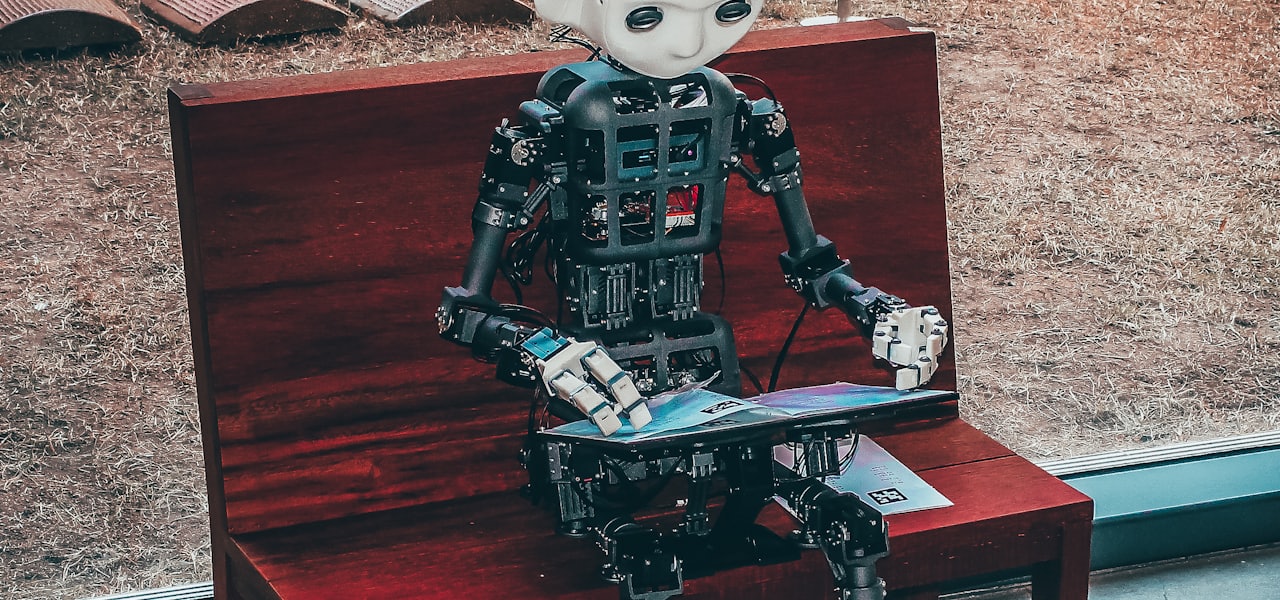
The impact of artificial intelligence on workers includes both applications to improve worker safety and health, and potential hazards that must be controlled. One potential application is using AI to eliminate hazards by removing humans from hazardous situations that involve risk of stress, overwork, or musculoskeletal injuries. Predictive analytics may also be used to identify conditions that may lead to hazards such as fatigue, repetitive strain injuries, or toxic substance exposure, leading to earlier interventions. Another is to streamline workplace safety and health workflows through automating repetitive tasks, enhancing safety training programs through virtual reality, or detecting and reporting near misses. When used in the workplace, AI also presents the possibility of new hazards. These may arise from machine learning techniques leading to unpredictable behavior and inscrutability in their decision-making, or from cybersecurity and information privacy issues. Many hazards of AI are psychosocial due to its potential to cause changes in work organization. These include increased monitoring leading to micromanagement, algorithms unintentionally or intentionally mimicking undesirable human biases, and assigning blame for machine errors to the human operator instead. AI may also lead to physical hazards in the form of human–robot collisions, and ergonomic risks of control interfaces and human–machine interactions. Hazard controls include cybersecurity and information privacy measures, communication and transparency with workers about data usage, and limitations on collaborative robots. From a workplace safety and health perspective, only "weak" or "narrow" AI that is tailored to a specific task is relevant, as there are many examples that are currently in use or expected to come into use in the near future. Certain digital technologies are predicted to result in job losses. Starting in the 2020s, the adoption of modern robotics has led to net employment growth. However, many businesses anticipate that automation, or employing robots would result in job losses in the future. This is especially true for companies in Central and Eastern Europe. Other digital technologies, such as platforms or big data, are projected to have a more neutral impact on employment. A large number of tech workers have been laid off starting in 2023; many such job cuts have been attributed to artificial intelligence. == Health and safety applications == In order for any potential AI health and safety application to be adopted, it requires acceptance by both managers and workers. For example, worker acceptance may be diminished by concerns about information privacy, or from a lack of trust and acceptance of the new technology, which may arise from inadequate transparency or training. Alternatively, managers may emphasize increases in economic productivity rather than gains in worker safety and health when implementing AI-based systems. === Eliminating hazardous tasks === AI may increase the scope of work tasks where a worker can be removed from a situation that carries risk. In a sense, while traditional automation can replace the functions of a worker's body with a robot, AI effectively replaces the functions of their brain with a computer. Hazards that can be avoided include stress, overwork, musculoskeletal injuries, and boredom. This can expand the range of affected job sectors into white-collar and service sector jobs such as in medicine, finance, and information technology. === Analytics to reduce risk === Machine learning is used for people analytics to make predictions about worker behavior to assist management decision-making, such as hiring and performance assessment. These could also be used to improve worker health. The analytics may be based on inputs such as online activities, monitoring of communications, location tracking, and voice analysis and body language analysis of filmed interviews. For example, sentiment analysis may be used to spot fatigue to prevent overwork. Decision support systems have a similar ability to be used to, for example, prevent industrial disasters or make disaster response more efficient. For manual material handling workers, predictive analytics and artificial intelligence may be used to reduce musculoskeletal injury. Traditional guidelines are based on statistical averages and are geared towards anthropometrically typical humans. The analysis of large amounts of data from wearable sensors may allow real-time, personalized calculation of ergonomic risk and fatigue management, as well as better analysis of the risk associated with specific job roles. Wearable sensors may also enable earlier intervention against exposure to toxic substances than is possible with area or breathing zone testing on a periodic basis. Furthermore, the large data sets generated could improve workplace health surveillance, risk assessment, and research. === Streamlining safety and health workflows === AI has also been used to attempt to make the workplace safety and health workflow more efficient. One example is coding of workers' compensation claims, which are submitted in a prose narrative form and must manually be assigned standardized codes. AI is being investigated to perform this task faster, more cheaply, and with fewer errors. == Hazards == There are several broad aspects of AI that may give rise to specific hazards. The risks depend on implementation rather than the mere presence of AI. Systems using sub-symbolic AI such as machine learning may behave unpredictably and are more prone to inscrutability in their decision-making. This is especially true if a situation is encountered that was not part of the AI's training dataset, and is exacerbated in environments that are less structured. Undesired behavior may also arise from flaws in the system's perception (arising either from within the software or from sensor degradation), knowledge representation and reasoning, or from software bugs. They may arise from improper training, such as a user applying the same algorithm to two problems that do not have the same requirements. Machine learning applied during the design phase may have different implications than that applied at runtime. Systems using symbolic AI are less prone to unpredictable behavior. The use of AI also increases cybersecurity risks relative to platforms that do not use AI, and information privacy concerns about collected data may pose a hazard to workers. === Psychosocial === Psychosocial hazards are those that arise from the way work is designed, organized, and managed, or its economic and social contexts, rather than arising from a physical substance or object. They cause not only psychiatric and psychological outcomes such as occupational burnout, anxiety disorders, and depression, but they can also cause physical injury or illness such as cardiovascular disease or musculoskeletal injury. Many hazards of AI are psychosocial in nature due to its potential to cause changes in work organization, in terms of increasing complexity and interaction between different organizational factors. However, psychosocial risks are often overlooked by designers of advanced manufacturing systems. Einola and Khoreva explore how different organizational groups perceive and interact with AI technologies. Their research shows that successful AI integration depends on human ownership and contextual understanding. They caution against blind technological optimism and stress the importance of tailoring AI use to specific workplace ecosystems. This perspective reinforces the need for inclusive design and transparent implementation strategies. ==== Changes in work practices ==== Over-reliance on AI tools may lead to deskilling of some professions. When AI becomes a substitute for traditional peer collaboration and mentorship, there is a risk of diminishing opportunities for interpersonal skill development and team-based learning. Increased monitoring may lead to micromanagement and thus to stress and anxiety. A perception of surveillance may also lead to stress. Controls for these include consultation with worker groups, extensive testing, and attention to introduced bias. Wearable sensors, activity trackers, and augmented reality may also lead to stress from micromanagement, both for assembly line workers and gig workers. Gig workers also lack the legal protections and rights of formal workers. Newell & Marabelli argue that AI alters power dynamics and employee autonomy, requiring a more nuanced understanding of its social and organizational implications. There is also the risk of people being forced to work at a robot's pace, or to monitor robot performance at nonstandard hours. A 2025 preprint paper based on users' interactions with the AI chatbot Microsoft Copilot identified forty jobs that the author's claimed had high overlaps with the capabilities of AI. Some media outlets used this paper to report on jobs becoming obsolete. Cri
Outline of machine learning
The following outline is provided as an overview of, and topical guide to, machine learning: Machine learning (ML) is a subfield of artificial intelligence within computer science that evolved from the study of pattern recognition and computational learning theory. In 1959, Arthur Samuel defined machine learning as a "field of study that gives computers the ability to learn without being explicitly programmed". ML involves the study and construction of algorithms that can learn from and make predictions on data. These algorithms operate by building a model from a training set of example observations to make data-driven predictions or decisions expressed as outputs, rather than following strictly static program instructions. == How can machine learning be categorized? == An academic discipline A branch of science An applied science A subfield of computer science A branch of artificial intelligence A subfield of soft computing Application of statistics === Paradigms of machine learning === Supervised learning, where the model is trained on labeled data Unsupervised learning, where the model tries to identify patterns in unlabeled data Reinforcement learning, where the model learns to make decisions by receiving rewards or penalties. == Applications of machine learning == Applications of machine learning Bioinformatics Biomedical informatics Computer vision Customer relationship management Data mining Earth sciences Email filtering Inverted pendulum (balance and equilibrium system) Natural language processing Named Entity Recognition Automatic summarization Automatic taxonomy construction Dialog system Grammar checker Language recognition Handwriting recognition Optical character recognition Speech recognition Text to Speech Synthesis Speech Emotion Recognition Machine translation Question answering Speech synthesis Text mining Term frequency–inverse document frequency Text simplification Pattern recognition Facial recognition system Handwriting recognition Image recognition Optical character recognition Speech recognition Recommendation system Collaborative filtering Content-based filtering Hybrid recommender systems Search engine Search engine optimization Social engineering == Machine learning hardware == Graphics processing unit Tensor processing unit Vision processing unit == Machine learning tools == Comparison of machine learning software Comparison of deep learning software === Machine learning frameworks === ==== Proprietary machine learning frameworks ==== Amazon Machine Learning Microsoft Azure Machine Learning Studio DistBelief (replaced by TensorFlow) ==== Open source machine learning frameworks ==== Apache Singa Apache MXNet Caffe PyTorch mlpack TensorFlow Torch CNTK Accord.Net Jax MLJ.jl – A machine learning framework for Julia === Machine learning libraries === Deeplearning4j Theano scikit-learn Keras === Machine learning algorithms === == Machine learning methods == === Instance-based algorithm === K-nearest neighbors algorithm (KNN) Learning vector quantization (LVQ) Self-organizing map (SOM) === Regression analysis === Logistic regression Ordinary least squares regression (OLSR) Linear regression Stepwise regression Multivariate adaptive regression splines (MARS) Regularization algorithm Ridge regression Least Absolute Shrinkage and Selection Operator (LASSO) Elastic net Least-angle regression (LARS) Classifiers Probabilistic classifier Naive Bayes classifier Binary classifier Linear classifier Hierarchical classifier === Dimensionality reduction === Dimensionality reduction Canonical correlation analysis (CCA) Factor analysis Feature extraction Feature selection Independent component analysis (ICA) Linear discriminant analysis (LDA) Multidimensional scaling (MDS) Non-negative matrix factorization (NMF) Partial least squares regression (PLSR) Principal component analysis (PCA) Principal component regression (PCR) Projection pursuit Sammon mapping t-distributed stochastic neighbor embedding (t-SNE) === Ensemble learning === Ensemble learning AdaBoost Boosting Bootstrap aggregating (also "bagging" or "bootstrapping") Ensemble averaging Gradient boosted decision tree (GBDT) Gradient boosting Random Forest Stacked Generalization === Meta-learning === Meta-learning Inductive bias Metadata === Reinforcement learning === Reinforcement learning Q-learning State–action–reward–state–action (SARSA) Temporal difference learning (TD) Learning Automata === Supervised learning === Supervised learning Averaged one-dependence estimators (AODE) Artificial neural network Case-based reasoning Gaussian process regression Gene expression programming Group method of data handling (GMDH) Inductive logic programming Instance-based learning Lazy learning Learning Automata Learning Vector Quantization Logistic Model Tree Minimum message length (decision trees, decision graphs, etc.) Nearest Neighbor Algorithm Analogical modeling Probably approximately correct learning (PAC) learning Ripple down rules, a knowledge acquisition methodology Symbolic machine learning algorithms Support vector machines Random Forests Ensembles of classifiers Bootstrap aggregating (bagging) Boosting (meta-algorithm) Ordinal classification Conditional Random Field ANOVA Quadratic classifiers k-nearest neighbor Boosting SPRINT Bayesian networks Naive Bayes Hidden Markov models Hierarchical hidden Markov model ==== Bayesian ==== Bayesian statistics Bayesian knowledge base Naive Bayes Gaussian Naive Bayes Multinomial Naive Bayes Averaged One-Dependence Estimators (AODE) Bayesian Belief Network (BBN) Bayesian Network (BN) ==== Decision tree algorithms ==== Decision tree algorithm Decision tree Classification and regression tree (CART) Iterative Dichotomiser 3 (ID3) C4.5 algorithm C5.0 algorithm Chi-squared Automatic Interaction Detection (CHAID) Decision stump Conditional decision tree ID3 algorithm Random forest SLIQ ==== Linear classifier ==== Linear classifier Fisher's linear discriminant Linear regression Logistic regression Multinomial logistic regression Naive Bayes classifier Perceptron Support vector machine === Unsupervised learning === Unsupervised learning Expectation-maximization algorithm Vector Quantization Generative topographic map Information bottleneck method Association rule learning algorithms Apriori algorithm Eclat algorithm ==== Artificial neural networks ==== Artificial neural network Feedforward neural network Extreme learning machine Convolutional neural network Recurrent neural network Long short-term memory (LSTM) Logic learning machine Self-organizing map ==== Association rule learning ==== Association rule learning Apriori algorithm Eclat algorithm FP-growth algorithm ==== Hierarchical clustering ==== Hierarchical clustering Single-linkage clustering Conceptual clustering ==== Cluster analysis ==== Cluster analysis BIRCH DBSCAN Expectation–maximization (EM) Fuzzy clustering Hierarchical clustering k-means clustering k-medians Mean-shift OPTICS algorithm ==== Anomaly detection ==== Anomaly detection k-nearest neighbors algorithm (k-NN) Local outlier factor === Semi-supervised learning === Semi-supervised learning Active learning Generative models Low-density separation Graph-based methods Co-training Transduction === Deep learning === Deep learning Deep belief networks Deep Boltzmann machines Deep Convolutional neural networks Deep Recurrent neural networks Hierarchical temporal memory Generative Adversarial Network Style transfer Transformer Stacked Auto-Encoders === Other machine learning methods and problems === Anomaly detection Association rules Bias-variance dilemma Classification Multi-label classification Clustering Data Pre-processing Empirical risk minimization Feature engineering Feature learning Learning to rank Occam learning Online machine learning PAC learning Regression Reinforcement Learning Semi-supervised learning Statistical learning Structured prediction Graphical models Bayesian network Conditional random field (CRF) Hidden Markov model (HMM) Unsupervised learning VC theory == Machine learning research == List of artificial intelligence projects List of datasets for machine learning research == History of machine learning == History of machine learning Timeline of machine learning == Machine learning projects == Machine learning projects: DeepMind Google Brain OpenAI Meta AI Hugging Face == Machine learning organizations == === Machine learning conferences and workshops === Artificial Intelligence and Security (AISec) (co-located workshop with CCS) Conference on Neural Information Processing Systems (NIPS) ECML PKDD International Conference on Machine Learning (ICML) ML4ALL (Machine Learning For All) == Machine learning publications == === Books on machine learning === Mathematics for Machine Learning Hands-On Machine Learning Scikit-Learn, Keras, and TensorFlow The Hundred-Page Machine Learning Book === Machine learning journals === Machine Learning Journal of Machine Learning Research (JMLR) Neural Computation == Pe
Web Intents
Web Intents was an experimental framework for web-based inter-application communication and service discovery. Web Intents consists of a discovery mechanism and a very light-weight RPC system between web applications, modelled after the Intents system in Android. In the context of the framework an Intent equals an action to be performed by a provider. Web Intents allow two web applications to communicate with each other, without either of them having to actually know what the other one is. == Support == === Client === Google Chrome versions 18 to 23 natively supported Web Intents. This support was disabled in version 24, citing the existence of a "number of areas for development in both the API and specific user experience in Chrome". There is a JavaScript shim with support for IE 8, IE 9, Opera, Safari, Firefox 3+ and Chrome 3+. === Server === There are some Web Intents proxy pages that make available some real services that don't yet support intents. AddThis supports Web Intents by their sharing tools regardless of browser support. == History == Paul Kinlan of Google announced the Web Intents project in December 2010. He soon released a prototype API to GitHub. In August 2011 Google announced that Chrome would support Web Intents. Google and Mozilla have started co-operating to unify Web Intents and Mozilla's Web Activities (which tries to solve the same problem) into one proposal. In November 2012, Greg Billock of Google announced that experimental support of Web Intents had been removed from Chrome.
STIT logic
STIT logic (from seeing to it that) is a family of modal and branching-time logics for reasoning about agency and choice. A typical STIT operator has the form [ i s t i t : φ ] {\displaystyle [i\ {\mathsf {stit}}:\varphi ]} , usually read as "agent i {\displaystyle i} sees to it that φ {\displaystyle \varphi } ", and is interpreted in models where agents choose between alternative possible futures. STIT logics are used in action theory, deontic logic, epistemic logic, and the theory of intelligent agents to formalise notions such as "could have done otherwise", responsibility, joint action, and strategic ability in an indeterministic world. == Etymology == The acronym STIT comes from the English phrase "seeing to it that", introduced in influential work by Nuel Belnap and Michael Perloff on the logical analysis of agentive expressions. In this tradition, "to see to it that φ {\displaystyle \varphi } " is treated as a primitive agency operator, rather than being reduced to ordinary modal necessity. == History == Modern STIT logic arose in the 1980s in the context of branching-time semantics and formal theories of agency. Belnap and Perloff's article "Seeing to it that: A canonical form for agentives" introduced the idea of treating expressions of the form "agent i sees to it that φ" as a primitive modal operator, and analysed such sentences using a branching tree of moments and histories. This approach was further developed in a series of papers on indeterminism and agency and provided the conceptual core for later STIT formalisms. In the 1990s the basic formal systems of STIT logic were worked out. Horty and Belnap's influential paper on the deliberative STIT operator distinguished between a "Chellas" STIT that merely records the result of an agent's present choice and a "deliberative" STIT that requires the agent's choice to make a difference, and connected STIT with issues of action, omission, ability and obligation. Around the same time, Ming Xu proved completeness and decidability results for basic STIT systems, including a single-agent logic with Kripke-style semantics and axiomatizations for multi-agent deliberative STIT, thereby establishing STIT as a well-behaved normal modal framework. This early work was systematised in Belnap, Perloff and Xu's monograph Facing the Future: Agents and Choices in Our Indeterminist World, which presents a general branching-time semantics for individual and group STIT operators, discusses independence-of-agents conditions and articulates the metaphysical picture of an indeterministic "tree" of moments. At roughly the same time, Horty's book Agency and Deontic Logic developed deontic STIT logics in which obligations are tied to agents' available choices rather than to static states of affairs, and used the resulting systems to analyse "ought implies can", contrary-to-duty obligations and deontic paradoxes. These works helped to position STIT at the intersection of action theory, temporal logic and deontic logic. From the late 1990s and 2000s onward, STIT logics were combined with epistemic, temporal and strategic modalities. Broersen introduced complete STIT logics for knowledge and action and deontic-epistemic STIT systems that distinguish different modes of mens rea, with applications to responsibility and the specification of multi-agent systems. Work on group and coalitional agency investigated axiomatisations and complexity results for group STIT logics, and related STIT-based analyses of agency to coalition logic and alternating-time temporal logic (ATL) by exhibiting formal embeddings between the frameworks. Explicit temporal operators were added to STIT in so-called temporal STIT logics. Lorini proposed a temporal STIT with "next" and "until" operators along histories and showed how it can be applied to normative reasoning about ongoing behaviour and commitments. Ciuni and Lorini compared different semantics for temporal STIT, clarifying the relationships between branching-time, game-based and epistemic approaches, while Boudou and Lorini gave a semantics for temporal STIT based on concurrent game structures, thus strengthening links with standard models of multi-agent interaction used for ATL and strategy logic. In parallel, complexity-theoretic work by Balbiani, Herzig and Troquard and by Schwarzentruber and co-authors investigated the satisfiability and model-checking problems for various STIT fragments, showing for instance that many expressive group STIT logics are undecidable or of high computational complexity. In the 2010s, STIT ideas were combined with justification logic, imagination operators and refined deontic notions. Justification STIT logics, developed by Olkhovikov and others, merge explicit justifications with STIT-style agency so that producing a proof can itself be treated as an action that brings about knowledge, and they come with completeness and decidability results. Olkhovikov and Wansing introduced STIT imagination logics, together with axiomatic systems and tableau calculi, to model acts of voluntary imagining and their role in doxastic control. Other authors have proposed STIT-based logics of responsibility, blameworthiness and intentionality for use in philosophical and AI settings. Xu's survey article "Combinations of STIT with Ought and Know" (2015) reviews many of these developments and emphasises the interplay between deontic and epistemic STIT logics. Current research on STIT focuses on proof theory, automated reasoning and richer expressive resources. Lyon and van Berkel, building on earlier work on labelled calculi for STIT, have developed cut-free sequent systems and proof-search algorithms that yield syntactic decision procedures for a range of deontic and non-deontic multi-agent STIT logics and support applications such as duty checking and compliance checking in autonomous systems. Sawasaki has proposed first-order cstit-based STIT logics that can distinguish de re and de dicto readings of agency statements and has proved strong completeness results for Hilbert systems over finite models, moving the STIT programme beyond the purely propositional level. Further work investigates interpreted-system and computationally grounded semantics for STIT and its extensions in order to model the behaviour of autonomous agents in multi-agent settings, and proposes STIT-based semantics for epistemic notions based on patterns of information disclosure in interactive systems. == Branching-time semantics == STIT logics are usually interpreted over branching-time models. A standard STIT frame consists of: a non-empty set of moments T {\displaystyle T} , partially ordered by < {\displaystyle <} so that ( T , < ) {\displaystyle (T,<)} forms a tree (every pair of moments with a common predecessor has a greatest lower bound); a set of histories, each history being a maximal linearly ordered subset of T {\displaystyle T} ; a non-empty set of agents A g {\displaystyle Ag} ; for each agent i ∈ A g {\displaystyle i\in Ag} and moment m {\displaystyle m} , a choice function c h o i c e i m {\displaystyle {\mathsf {choice}}_{i}^{m}} that partitions the set of histories passing through m {\displaystyle m} into choice cells. The idea is that a moment represents a time at which choices are made, and histories represent complete possible future courses of events. At each moment, each agent's choice corresponds to selecting one of the available cells of histories determined by their choice function. Formulas are evaluated at pairs ( m , h ) {\displaystyle (m,h)} of a moment and a history through that moment (sometimes written m / h {\displaystyle m/h} ). A valuation assigns truth-values to atomic propositions at such indices; Boolean connectives are interpreted pointwise as in Kripke-style modal logic. == Chellas and deliberative STIT operators == Several STIT operators have been distinguished in the literature. A common approach uses two closely related operators, often called Chellas STIT and deliberative STIT. Let H m {\displaystyle H_{m}} be the set of histories passing through a moment m {\displaystyle m} , and write H m {\displaystyle H_{m}} ⟦ φ ⟧ m = { h ∈ H m ∣ M , m / h ⊨ φ } {\displaystyle {\text{⟦}}\varphi {\text{⟧}}_{m}=\{h\in H_{m}\mid M,m/h\models \varphi \}} for the set of histories at m {\displaystyle m} where φ {\displaystyle \varphi } holds. The Chellas STIT operator, often written [ i c s t i t : φ ] {\displaystyle [i\ {\mathsf {cstit}}:\varphi ]} , is given by M , m / h ⊨ [ i c s t i t : φ ] iff c h o i c e i m ( h ) ⊆ ⟦ φ ⟧ m . {\displaystyle M,m/h\models [i\ {\mathsf {cstit}}:\varphi ]\quad {\text{iff}}\quad {\mathsf {choice}}_{i}^{m}(h)\subseteq {\text{⟦}}\varphi {\text{⟧}}_{m}.} Intuitively, agent i {\displaystyle i} sees to it that φ {\displaystyle \varphi } if φ {\displaystyle \varphi } holds at all histories compatible with their present choice. The deliberative STIT operator, [ i d s t i t : φ ] {\displaystyle [i\ {\mathsf {dstit}}:\varphi ]} , adds